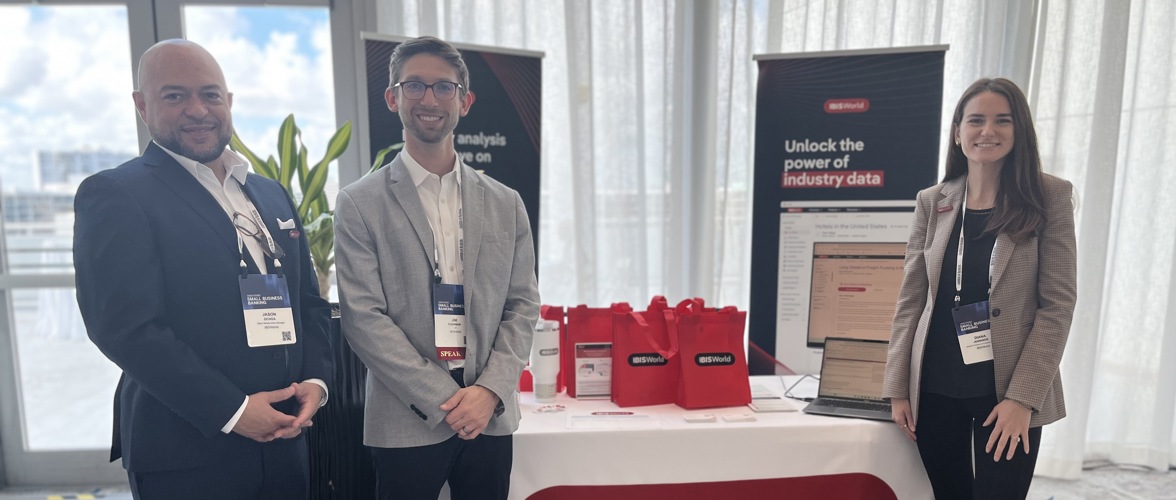


At the 2025 American Banker Small Business Banking Conference in Florida, a central theme emerged across sessions and hallway conversations alike: in today’s uncertain economy, small business success—and by extension, small business banking success—requires understanding customers from every possible angle.
That idea came to life during a panel titled “Strategies and Tools for Banks to Help SMBs Deal with Costly Market Disruptions,” featuring Andrew Davis, Head of Macroeconomic Research at Bryn Mawr Trust; Jim Fuhrman, Vice President of Commercial Banking at IBISWorld; and Candice Caruso, Chief Business Banking Officer at WSFS Bank. Together, they explored how a layered understanding of small businesses—from macroeconomic trends to sector dynamics to individual client sentiment—can inform better banking relationships and more resilient portfolios.
Their message was clear: to win in small business banking, financial institutions must combine macro foresight, industry fluency, and micro-level empathy. Each lens reveals distinct insights, but it’s their integration that creates a complete picture.
The macro view: “Slowing, not stalling”
Andrew Davis opened the conversation with a dose of measured optimism. “The story of 2025 is slowing, not stalling,” he explained. “We’re in a phase of modest growth and resilience.”
GDP growth hovers around 2%, inflation continues to ease gradually, and the Federal Reserve has begun signaling a shift from restrictive to balanced policy. Davis expects rates to settle near 3.75% by late 2025, creating what he called a “balanced money” environment—not cheap, but predictable.

Labor markets, while cooling, remain healthy with wage growth around 4%. Yet the picture is far from uniform. Davis noted the “bifurcation of the consumer”—higher-income households continue to spend on services, travel, and dining, while lower-income consumers face tighter budgets due to borrowing costs and dwindling savings.
For bankers, this unevenness means opportunity is increasingly selective. “The challenge isn’t just knowing where growth is,” Davis said, “it’s understanding who is still spending, where, and why.”
Actionable takeaway: Banks should strengthen their data and segmentation strategies to align lending and marketing with these evolving spending patterns. That means monitoring regional indicators, anticipating where wage resilience will sustain demand, and focusing relationship-building in those pockets. In a world of modest aggregate growth, localized intelligence becomes the new competitive advantage.
The industry view: Navigating disruption with precision
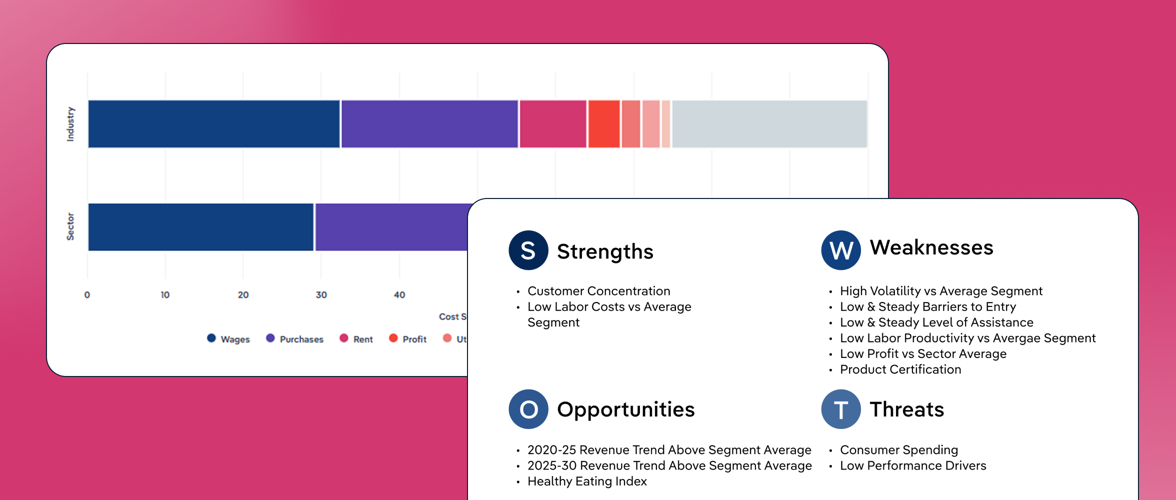
Turning from macro forces to industry-level dynamics, Jim Fuhrman of IBISWorld emphasized how today’s most resilient small businesses are those that understand and adapt quickly to their sector’s unique pressures.
“Tariffs have replaced ‘COVID’ as the buzzword,” he said, “but the underlying issue hasn’t changed: exposure to input cost volatility.” Rather than fixating on headlines, Fuhrman urged bankers to look deeper into how different industries experience and mitigate these pressures.
To illustrate, he pointed to a classic Main Street coffee shop—a sector both vulnerable and nimble. Unlike national chains such as Starbucks, which have shuttered hundreds of stores amid cost and traffic challenges, small coffee shops often survive through micro-level agility.

When global coffee prices spiked, many local café owners diversified their menus, adding snack offerings—often locally sourced or homemade—to offset rising bean costs and avoid tariff impacts on imported goods. Others partnered with local bakeries or co-packers, transforming supply chain risk into a community-based value proposition.
This example underscores a key principle for bankers: small businesses make tactical, not structural, adjustments. Their margins are thin and their capital buffers limited, but their ability to pivot quickly can make them surprisingly resilient when supported by the right financial partner.
Actionable takeaway: Banks should tailor industry-specific outreach and lending strategies. Equip relationship managers (RMs) with sector-specific intelligence tools that reveal how peers are adapting, such as benchmark data on inventory strategies or supplier diversification. This “sector fluency” not only builds credibility, it also directly correlates with client retention: small businesses with an industry-savvy RM are three times less likely to switch banks, and their satisfaction scores are exponentially higher.
The micro view: Sentiment and service at the front lines
Bringing the conversation from the boardroom to the branch, Candice Caruso shared a real-world perspective from WSFS Bank, where small business optimism is rebounding—cautiously.
According to recent surveys, 84% of business owners in the Philadelphia region report optimism about their prospects, and the U.S. Chamber’s Q3 Small Business Index reached a multi-year high. Yet, Caruso cautioned, optimism coexists with anxiety. “Owners are feeling the relief of stability, but they’re still fighting higher costs, hiring challenges, and cash flow pressures,” she said.
Those pain points are exactly where WSFS has focused its innovation. Caruso detailed how the bank’s Cash Flow Solutions bundle, Smart Safe offerings, and SBA lending programs help small businesses manage liquidity and payment efficiency—practical tools that open the door to deeper treasury relationships.

But Caruso was quick to emphasize that products alone don’t differentiate a bank—people do. WSFS’s Trusted Advisor Program trains associates to lead with consultation, not promotion. “We invest in understanding our clients — their business model, their industry pressures, and their goals,” she explained. “Only then can we make the right recommendations.”
Actionable takeaway: Banks should embed consultative training and data-driven playbooks across their small business teams. Empower RMs to act as advisors who understand the client’s financial ecosystem — not just product sellers. The payoff is quantifiable: clients who view their banker as part of their advisory team are more than twice as likely to expand their relationship within a year.
Integrating the three lenses: From insight to action
The panelists agreed that sustainable small business banking success depends on integrating macro, industry, and client-level insights into a cohesive strategy.
From Davis’s macro perspective, this means tracking the right indicators—employment resilience, regional demand patterns, and credit spreads—to anticipate where opportunity will emerge next. From Fuhrman’s industry angle, it means embedding sector intelligence into frontline conversations so bankers can contextualize challenges rather than generalize them. And from Caruso’s micro view, it means translating insight into empathy, equipping teams to solve for the individual business owner’s needs.
The synergy of these levels forms a “3D understanding” of the client. Banks that achieve it will differentiate not by rate or technology alone, but by contextual intelligence—the ability to combine economic awareness, sector knowledge, and relational trust into every interaction.
The road ahead: What a thriving bank looks like in 2026
When asked for one piece of advice for bankers, all three panelists converged on the same principle: know your customer—in data, in context, and in conversation.
The thriving banks of 2026 will be those that:
- Marry data with empathy: combining macro insight and local intelligence.
- Invest in their people: pulling bankers “off the floor” to deepen expertise.
- Operate with agility: adapting offerings and technology to real-time client needs.
As Caruso concluded, “Small business owners want what we all want—a partner who understands their world.” In a market defined by uncertainty, that understanding isn’t just a competitive advantage; it’s the foundation of lasting growth.
About the panelists
Jim Fuhrman is Vice President of Commercial Banking at IBISWorld. With more than a decade of experience helping financial institutions translate market intelligence into growth strategies, he specializes in connecting macroeconomic data to on-the-ground execution. A frequent speaker across North America, Fuhrman champions industry fluency as a driver of client loyalty and long-term profitability.
Andrew Davis serves as Director of Macroeconomics Research and Investment Strategies at Bryn Mawr Trust, where he leads the firm’s macro outlook and cross-asset research. A CFA® charterholder, Davis previously held roles at SEI Investments, Moody’s Analytics, and the Bureau of Labor Statistics. His work focuses on translating data into actionable strategy for investors and financial institutions alike.
Candice Caruso is Senior Vice President and Chief Business Banking Officer at WSFS Bank, leading the growth of the bank’s small business and SBA portfolio. With more than 20 years in financial services, she has been recognized for expanding access to capital and advancing relationship-based banking. A frequent industry voice, Caruso was honored with the American Banker “Next” award as one of the Most Powerful Women in Banking.