


Australia stands at the edge of a new industrial era. The shift to net zero, rapid digitisation, an ageing population and global supply chain realignment are all converging to redefine our economic base.
These forces aren’t operating in isolation. Clean energy is reshaping power and resource demand, digitisation is redefining productivity, and demographic change is rewriting the health and skills agenda. Together, they’re determining where Australia’s next wave of growth will come from , and how to make its economy globally competitive.
In this new white paper, IBISWorld Sr. Industry Analyst Joshua Campbell explore the structural forces reshaping Australia’s economy and identify the industries best positioned to capture long-term advantage.
Join Julia Saladino, Head of Research at IBISWorld, and Josh Campbell as they delve into the highlights of the White Paper in the full discussion video below.
What’s in the white paper?
This in-depth analysis brings together the four macro forces driving structural change, pinpointing six industries where those forces converge to create competitive advantage.
The macro forces shaping Australia’s next growth era
1. Energy transition
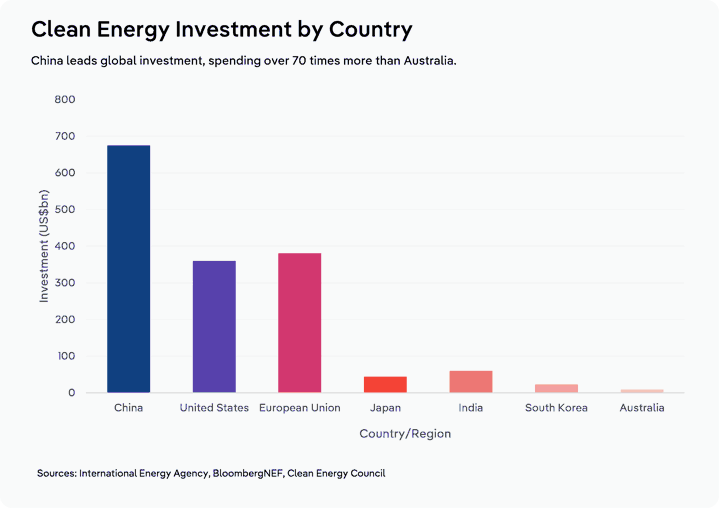
Decarbonisation is the foundation of every future industry. Clean-energy investment reached record highs in 2024, yet grid congestion and project bottlenecks threaten progress. The paper outlines where faster transmission and storage buildout could unlock new industrial precincts and export capacity.
2. Digital transformation
Australia’s data capacity is expected to more than double by 2030. Data centres, AI infrastructure and connectivity are becoming critical productivity inputs, not background utilities. Coordinated energy and data policy will determine whether Australia can scale efficiently.
3. Demographic ageing
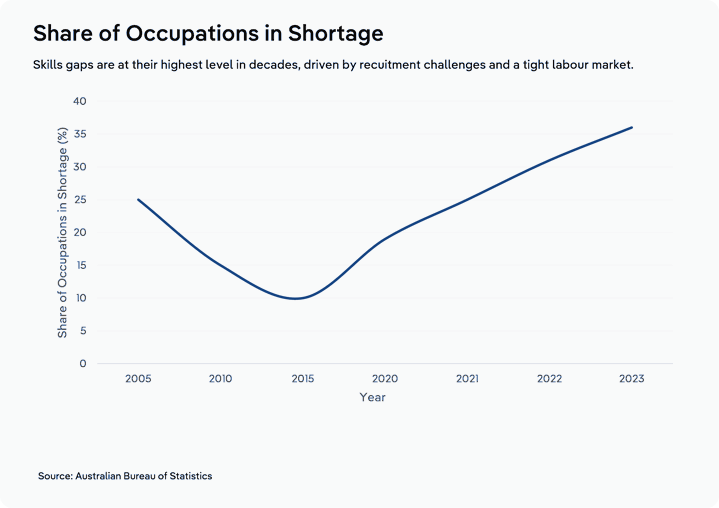
Record-low fertility and rising care demand are reshaping both the workforce and consumption. Health, biotech and care sectors will define the next phase of domestic expansion, but success depends on workforce scaling and training alignment.
4. Geopolitical realignment
Global supply chains are fragmenting, driving investment in secure local capabilities. For Australia, this opens opportunities across defence, critical minerals and advanced manufacturing, if capital, skills and supply chains can scale together.
The sectors where these forces converge
Clean energy and green industrialisation
Renewables, hydrogen and green metals will anchor the next export wave. The paper shows how investment coordination across power, transport and industrial precincts is key to competitiveness.
Digital infrastructure and data industries
Data centres and connectivity are now strategic infrastructure. The paper outlines how digital capacity underpins productivity across every sector.
Health and biotechnology
From mRNA and cell therapy to precision medicine, Australia has strong research capability, but needs to expand manufacturing and regulatory capacity to capture global opportunity.
Advanced manufacturing
Automation, robotics and reshoring are redefining competitiveness. The paper quantifies how digital adoption could lift mid-tier manufacturers’ productivity and output.
Space and defence
Australia’s role is shifting from client to co-developer. Sovereign capability in satellites, sensors and autonomous systems can strengthen industrial depth and national resilience.
Critical minerals and resources
Value creation will depend on processing, refining and integration into clean-tech supply chains, not just extraction.
Why now?
2025 marks a pivotal moment for industrial coordination. The global race to decarbonise, digitise and localise production is accelerating, yet Australia’s planning and delivery systems still move in silos. Without alignment between policy, capital, infrastructure and skills, the window to capture global investment could close quickly.
This paper outlines the conditions required to turn natural advantages into sustainable competitiveness, from faster project approvals to strategic workforce planning.
Final Word
Australia’s next growth story will be written by the businesses and investors able to read the signals early, where energy, technology, skills and capital align.
This white paper is essential reading for professionals in investment strategy, infrastructure and industry analysis, and across energy, manufacturing, technology and defence.
Whether you’re evaluating markets, structuring investments, or advising clients on growth, this paper gives you the context needed to understand and act on Australia’s emerging industrial opportunities.