

Record-low unemployment might sound like good news, but for many sectors, it’s become a serious constraint.
Critical sectors including healthcare, education, construction and mining are all struggling to find staff, with persistent shortages slowing productivity, limiting growth and pushing up costs. While cyclical pressures are part of the story, the deeper issue lies in structural constraints that won’t resolve quickly.
In this white paper, Senior Industry Analysts Callum Francis and Nicholas Larter explore the forces reshaping Australia’s labour market, and what government and business can do to build a more resilient workforce.
What’s in the white paper?
This in-depth analysis unpacks the demographic, structural and policy factors driving labour shortages and what can realistically be done to ease them.
A changing population
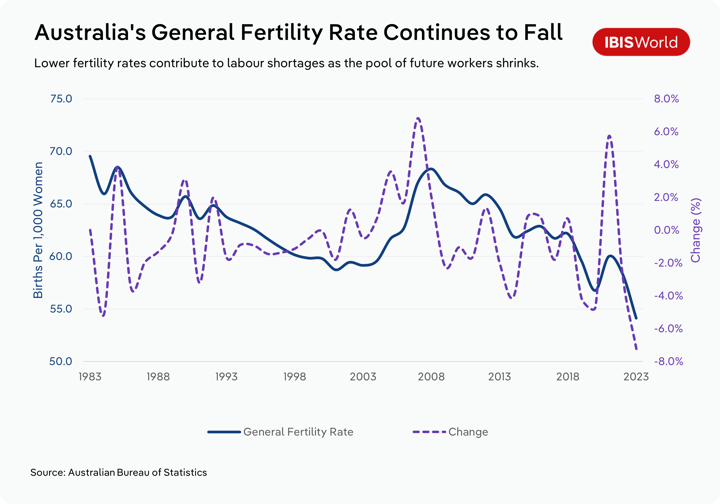
Australia’s birth rate has remained below the replacement level of 2.1 since the 1970s and just hit a record low. As the population ages, more workers are leaving the labour market than entering it, particularly in care-intensive and physically demanding roles.
Tight conditions, long pipelines
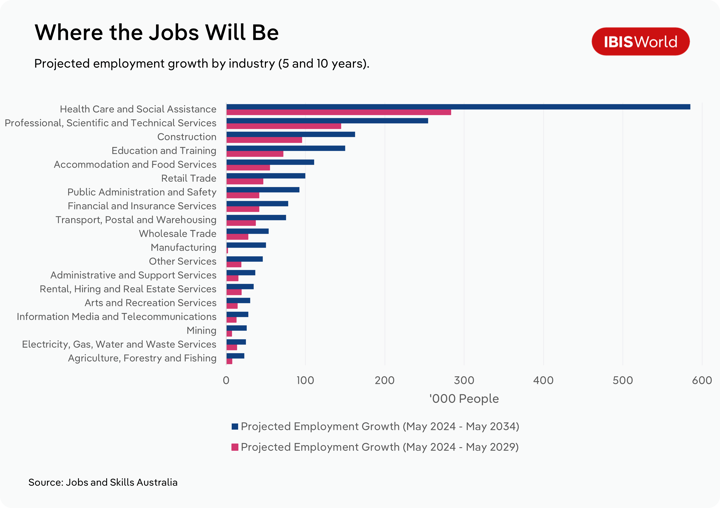
Nearly 2 million new jobs are expected by 2034, but many sectors won’t be able to fill them with current training pipelines. Long lead times, declining completions and placement gaps are limiting supply, especially in education, construction and care roles.
Migration policy under pressure
Migration has historically filled labour gaps. But recent caps, tightened student visa rules and cost-of-living pressures are narrowing that pipeline, even in sectors that depend heavily on migrant workers. These changes are arriving just as demand intensifies.
Government responses underway
Federal and state governments are expanding fee-free TAFE, offering student placement payments and reforming visa programs to support priority sectors. A shift to 4-year migration planning is also in motion. But policy lags, retention challenges and entrenched job perceptions continue to limit delivery.
Sector-specific breakdowns
Shortages in construction, health and aged care, education, mining, manufacturing and hospitality are explored in depth, including the underlying causes, policy responses and what’s working (and what’s not). For example, aged care alone may face a shortfall of more than 200,000 workers by 2050, while the construction industry needs an extra 130,000 workers to meet housing targets.
Workforce participation gaps
Australia’s underutilisation rate currently sits at 10.1%, yet older Australians, women, people with disability and migrants remain underrepresented in many industries. Barriers to entry, support gaps and lack of career pathways limit the ability of these groups to close workforce gaps.
What business can do now
The paper offers practical, research-backed strategies for employers, from adapting job design and working conditions, to supporting retention through wellbeing initiatives and career development. Many are also partnering with training providers to build future pipelines.
Why now?
Australia’s labour challenges are not temporary. The combined effects of an ageing population, slowing migration, limited training capacity and changing worker expectations will continue to shape hiring decisions and policy responses for years to come.
As the country aims to deliver 1.2 million new homes, transition to net zero and care for an ageing population, labour availability will be a key constraint (or enabler) for success.
Governments are responding with new funding, migration and training policies, but delivery gaps remain. Even well-funded programs struggle to overcome entrenched barriers like poor retention, low placement uptake and high turnover in high-pressure roles.
Final Word
If your organisation relies on access to skilled labour, or if you're responsible for workforce planning, economic advice and investment decisions, this paper is essential reading.
You’ll benefit from this paper if you work in government or economic policy, construction, mining, healthcare or education. It’s also relevant for those in consulting or advisory services, vocational training, tertiary education or skills planning, recruitment, workforce development or HR strategy, financial services and commercial lending, and infrastructure, energy or manufacturing.
Ready to explore the full analysis? Fill out the form above to instantly download the complete white paper.