

Key Takeaways
- AI’s impact on workforce strategy requires executives to assess where it can replace, amplify, or transform work for the greatest advantage.
- A disciplined framework for AI integration ensures initiatives are tied to business outcomes, focused on high-impact workflows, and scaled only when proven.
- External benchmarks provide a shared foundation for aligning AI strategy with execution and sustaining competitive momentum over time.
A global consulting firm had everything lined up. Client demand was climbing, margins were strong, and the leadership team had just approved an aggressive expansion into new verticals. The market was ready. The pipeline was full. The strategy looked airtight.
But midway through execution, delivery began to slip. Senior consultants were stretched thin, recruitment cycles dragged on, and wage pressure for top-tier talent outpaced projections. The firm turned to AI as a potential lever, but the leadership team couldn’t align. Should they automate research and modeling workflows? Use AI to augment proposal writing and project management? Or wait until the technology proved more stable? While internal debates stalled progress, competitors had already deployed AI-driven tools that cut turnaround times in half and scaled project teams without increasing headcount.
As someone who works with leaders in organizations across many industries, this story reflects what many of our clients face today.
In 2025, the competitive wildcard is not just finding people. It is deciding where AI can replace, amplify, or transform the human side of operations. Labor constraints still matter, but so does knowing when and how to integrate AI into the very fabric of the business model.

AI is no longer a side project for innovation teams; I’ve witnessed it become a workforce variable that belongs in the same conversation as headcount planning, wage pressure, and productivity. Treating it as optional is as risky as ignoring your top-line revenue forecast, because the companies that get AI workforce integration right will capture the high ground before others can react.
How AI has redefined workforce strategy
For years, workforce planning was about balancing three levers: the number of people, the cost of employing them, and the productivity they could deliver. The calculus was difficult but familiar. Now AI has rewritten that equation.
In many industries, the question is no longer whether AI can be applied, but where it will have the greatest strategic impact. Early adopters are already showing what is possible: faster deal cycles, leaner operations, sharper forecasting, and service models that scale without adding headcount. For executives under pressure to deliver growth in a constrained labor market, the appeal is obvious.
But the reality is more complex. AI is not a uniform solution. In some sectors it can replace entire categories of work. In others it serves as an amplifier, allowing existing teams to deliver more without burnout or costly expansion. The right answer depends on the operating model, the competitive landscape, and the unique constraints of the workforce in question.

This is why the decision belongs in the C-suite. Integrating AI into core strategy requires the same rigor applied to mergers, capital allocation, or market entry. Executives must weigh not only the potential upside but also the operational readiness of their teams, the regulatory environment of their industry, and the cultural implications of automation.
In this environment, industry research becomes more than a background check. It is the foundation for understanding how labor trends, cost structures, and productivity benchmarks intersect with AI’s potential in your sector. Without that external perspective, leaders risk chasing AI initiatives that look promising in theory but fail to deliver meaningful leverage in practice.
The companies that succeed will not simply adopt AI. They will integrate it into workforce strategy with precision, targeting the functions and markets where it creates sustainable advantage and avoiding the hype-driven moves that drain resources and erode trust.
Reading the signs of AI readiness
Identifying where AI will create lasting value starts with understanding the current state of the industry and its workforce dynamics. Not every market is ready for automation or augmentation at scale, and not every function within a business will yield the same return on investment. The following indicators can help executives pinpoint where AI adoption is most likely to generate measurable results.
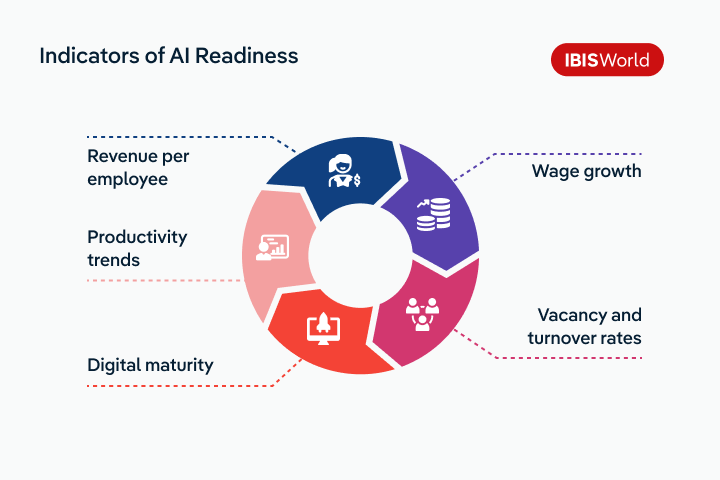
Revenue per employee
This metric reflects the value each worker produces on average. High revenue per employee suggests roles are highly skilled and less easily automated in full, but AI can increase impact by removing repetitive or administrative tasks. Lower revenue per employee often indicates a process-heavy environment where automation can lift margins by streamlining operations.
Wage growth
Wage growth measures the pace at which labor costs are increasing. Declining wage growth can indicate that competitive pressure for certain skills is easing, often due to technology adoption or shifts in labor demand. This may signal that AI has already begun to reshape the market, reducing scarcity for some roles while increasing the relative value of others. Conversely, accelerating wage growth in specific functions can highlight areas where automation could help contain costs and maintain competitiveness without sacrificing capability.
Productivity trends
Flat or declining productivity despite investment in tools and technology can signal inefficiencies that AI might resolve. In industries where output per worker is slipping, AI can help redesign workflows, eliminate bottlenecks, and free up human capital for higher-value activities.
Vacancy and turnover rates
Chronic difficulty in filling key roles or retaining talent is a strong signal to consider AI. Automating parts of these functions can reduce dependence on scarce skills, maintain service quality, and ease the pressure on recruitment teams.
Digital maturity
Industries with well-developed digital infrastructure tend to integrate AI more quickly and with fewer operational disruptions. Sectors that lag in digital adoption may face longer lead times for AI integration, but targeted investment in readiness can still yield a significant competitive edge.

Using these indicators together creates a multidimensional view of AI readiness. The most effective strategies will combine industry benchmarks with internal performance data to reveal where AI can deliver the most sustainable advantage, whether through cost savings, productivity gains, or faster time to market.
Amplification or replacement?: The strategic crossroads for AI
For executives, deciding how to integrate AI is not a purely technical question. It is a choice about the future shape of the business, the balance of human and machine capability, and the culture that will sustain performance. In boardrooms across industries, the conversation tends to fall into two broad camps.
Amplification
This approach uses AI to make existing teams faster, sharper, and more effective without fundamentally changing their roles. In high-skill, high-value environments such as investment banking, consulting, or advanced manufacturing, AI can absorb repetitive tasks, accelerate analysis, and free professionals to focus on strategic, client-facing, or creative work. Amplification is often the preferred choice where brand reputation depends heavily on human judgment and relationship capital.
Replacement
In some contexts, the case for AI-led automation is clear. Rules-based, repetitive, and transactional workflows can often be handled more consistently and at lower cost by AI than by human teams. In sectors with high vacancy rates or rapid cost inflation in low- to mid-skill roles, full or partial replacement can protect margins and service levels without the strain of constant recruitment. From speaking with clients, this has been most effective in roles where high vacancy rates and rising labor costs are constant pain points.
Finding the balance
The choice is rarely all-or-nothing. Most businesses will find that the optimal strategy is a portfolio approach, applying AI differently across functions. Some roles may be redesigned entirely around AI capabilities, others will be supported by AI tools, and some will remain largely human-driven. Determining this balance requires an external perspective on where AI will deliver the greatest leverage.

Market-level benchmarks on productivity, wage growth, and digital maturity can highlight where amplification will offer a competitive edge and where replacement is both possible and prudent. Without this grounding, companies risk overinvesting in AI where returns are marginal or underinvesting in areas where the competitive clock is already ticking.
A C-suite framework for AI integration
Integrating AI is not just a technology upgrade. It is a leadership decision that shapes strategy, operations, culture, and competitive position. Executives must move from ambition to a disciplined process that links AI initiatives to measurable results, balancing speed with control and grounding decisions in both internal priorities and market benchmarks. The four steps that follow outline how to evaluate, pilot, and scale AI while protecting resources and building lasting advantage.
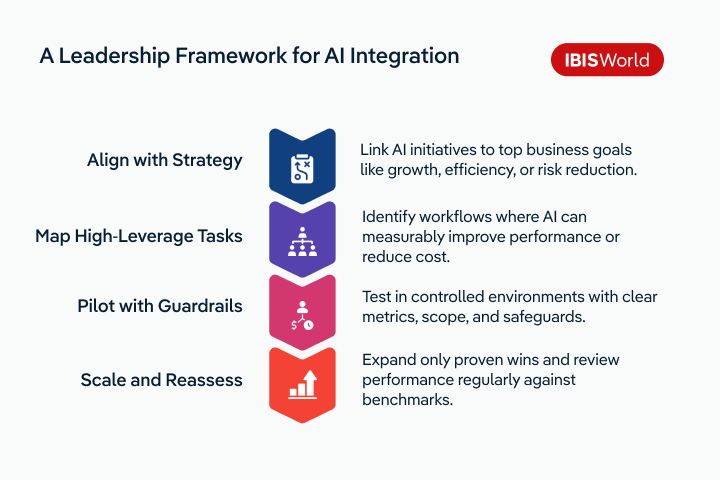
1. Anchor AI to business outcomes
Every AI initiative should begin with a clear link to the company’s most pressing strategic goals. Executives must decide which outcomes matter most in the near term and over the next two years, whether that is revenue growth, margin expansion, risk reduction, or improved customer experience. This requires both internal clarity and external validation. Industry benchmarks can show what peers achieve on similar metrics, helping to set realistic targets and avoid chasing projects with limited upside. By starting with a ranked list of high-priority outcomes, leadership can ensure AI investments are focused on measurable, high-value impact rather than experimentation for its own sake.
2. Identify where AI can create the most leverage
The next step is to map work at the level of tasks and workflows rather than broad job roles. This allows executives to pinpoint where value is created or lost, and where AI could meaningfully change the equation. Data on time spent, error rates, cycle times, and compliance requirements should be combined with external benchmarks on productivity, wage growth, and process complexity in the industry. The goal is to isolate a short list of workflows that are both operationally significant and realistically automatable, giving leadership a clear starting point for pilot projects.
3. Pilot with purpose and control
Once priority workflows are identified, the focus shifts to controlled experimentation. Pilots should be designed with a clear scope, success thresholds, and safeguards to protect brand, customers, and compliance. Baseline metrics such as cycle time, cost per unit, and error rate must be documented so improvements can be measured objectively. Industry research can inform expectations, providing reference points for what is achievable in similar contexts. This disciplined approach ensures that AI adoption is grounded in evidence and that scaling decisions are based on demonstrable results, not assumptions.

4. Scale what works and review regularly
After the pilot phase, executives must decide whether to expand, pause, or retire the initiative. Scaling should only occur when results clearly exceed baseline metrics and deliver sustained value. Even successful deployments should be reviewed quarterly against updated industry benchmarks and internal performance data to ensure they remain competitive and relevant as market conditions evolve. This regular review process allows leadership to reallocate resources toward the highest-yield AI initiatives and avoid locking in investments that no longer deliver a strategic return.
Bridging the gap between AI vision and execution
Many AI strategies start with high expectations. The business case looks compelling, market signals point to opportunity, and leadership teams agree that AI belongs on the agenda. Yet somewhere between approval and implementation, progress slows. Pilots stall, adoption lags, and early enthusiasm gives way to frustration. The issue is rarely a lack of commitment; it is a disconnect between the assumptions made in the strategy phase and the realities faced during execution.
This gap often emerges because planning is done at a high level while delivery lives in the details. Leadership models the potential for faster cycles or lower costs but underestimates the time required for integration, the readiness of supporting systems, or the cultural impact on teams. Without a shared, data-driven view of the operating environment, each function works from different assumptions, making it harder to align on priorities and timelines.

Closing this gap requires two disciplines. First, strategies must be grounded in external benchmarks that show how AI adoption has unfolded in similar industries and conditions. This reduces reliance on optimistic projections and helps set achievable targets. Second, the integration plan must be specific enough to guide day-to-day execution, with clear decision points, defined measures of success, and an agreed process for revisiting priorities as conditions change.
When strategy and execution stay aligned, AI projects move faster, deliver clearer returns, and avoid the costly cycle of rework. The organizations that achieve this alignment will be the ones that turn AI from a promising concept into a sustained competitive advantage.
Final Word
The pattern I’ve seen in speaking with leaders is that AI isn’t optional, though figuring out where to start can be daunting. Success comes from identifying a few places where AI can most effectively support business goals, then building and adjusting from there.
AI is now a core variable in workforce strategy, not a side project for innovation teams. The executives who treat it as central to headcount planning, productivity, and competitive positioning will shape the next wave of market leaders. Success will not come from adopting AI for its own sake, but from aligning it tightly with business outcomes, targeting the functions where it delivers the greatest leverage, and scaling only when results are proven.
This requires the same discipline applied to any major strategic decision: grounding plans in external benchmarks, setting realistic expectations, and maintaining alignment between strategy and execution. It also demands a clear understanding of how AI interacts with the human side of the business, whether to replace certain workflows, amplify existing talent, or transform operating models entirely.
The high ground will go to leaders who act decisively, test strategically, and adapt as conditions change. In an era of both talent scarcity and rapid technological change, waiting is the greater risk.