
Explosive investment and viral adoption have pushed artificial intelligence to the top of the business agenda. Since the launch of ChatGPT, generative AI tools have entered the workflows of millions, promising rapid automation, cost savings and productivity gains. Tech leaders now forecast world-changing breakthroughs within years.
But beneath the headlines, the story is more nuanced.
While AI systems are advancing quickly, significant technical, economic and regulatory constraints remain. In most industries, these limits mean adoption is outpacing impact, especially when it comes to employment.
In this white paper, Lead Analyst Vlad Khaustovich dives into the tension between AI's promise and its real-world performance. Drawing on sector-level data, recent research and expert commentary, the paper explores how far AI has come and why its near-term economic effects are likely to be more gradual than disruptive.
What’s in the white paper?
This in-depth paper offers a clear-eyed assessment of AI’s current capabilities, constraints, and practical implications across industries.
AI investments are booming, but results are mixed
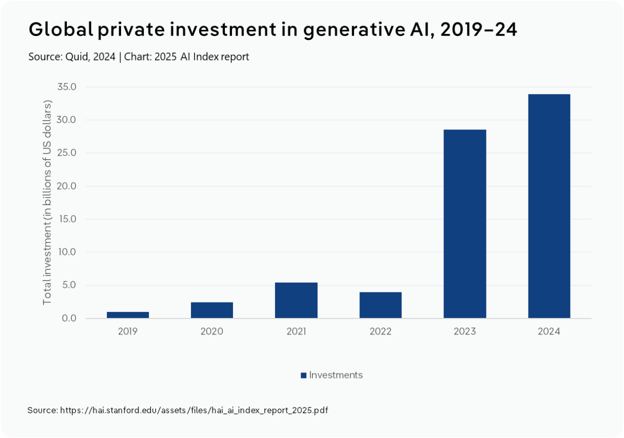
Global AI investment reached over $250 billion in 2024, with generative AI drawing a growing share. But most businesses report only modest gains, typically under 10% cost savings. Key technical limitations like hallucinations and poor reasoning persist even in flagship models.
Structural and regulatory roadblocks slow disruption
From legal liability to licensing rules, many sectors are shielded by institutional structures that AI can't easily penetrate. Even where tools exist, rules around accountability and data privacy limit how far AI can go.
Sector-specific insights
The paper breaks down AI’s impact across key industries:
- Finance: Strong interest, cautious rollout. Customer-facing tools still rely on traditional NLP, not generative AI.
- Education: Faculty are adapting to AI in classrooms and content, but employment impacts remain modest.
- Professional Services: AI is automating internal support functions, not replacing high-skill roles.
- Retail: E-commerce leaders like Amazon are pushing AI hardest, but most retail sales remain offline.
The productivity puzzle
Despite rapid adoption, productivity growth has remained within historical norms. Like past technologies, AI may follow a slow-burn path, with major gains only emerging over decades.
Why now?
Generative AI is moving fast, but its risks, limitations and long implementation timelines are often overlooked. Many businesses are making early bets based on speculative benefits, even as the most impactful use cases remain years away.
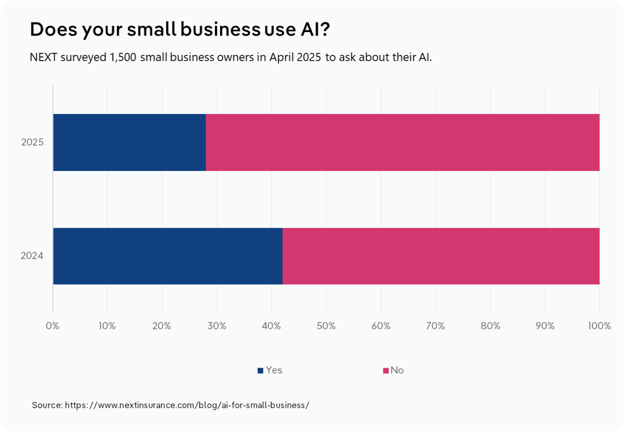
As the policy, legal and technical environment continues to evolve, this white paper helps decision-makers separate signal from noise and take a grounded approach to AI readiness.
Who should read this white paper?
If you're advising, investing in, or planning for AI’s impact, this paper is essential reading. You’ll benefit if you work in:
- Economic policy, regulation or technology strategy
- Banking, finance or insurance
- Education, research or skills development
- Consulting, legal services or enterprise IT
- Retail, logistics or digital product management
- Workforce planning, HR or risk advisory