
IBISWorld Platform
Answer any industry question in minutes with our entire database at your fingertips.

Gym mania has taken hold globally and Ireland is no exception. Health awareness has moved up the agenda for many Irish people, aided by post-pandemic habits and social media trends that have drawn more attention to our appearance. Irish customers are turning to gyms and fitness centres as they pursue their fitness goals and look for places that help them stay motivated. The industry is heavily fragmented, with a handful of chains like FLYEfit and BD Gyms clustered around urban hotspots, while the majority of gyms and fitness centres are small companies serving local communities across Ireland’s countryside.
Answer any industry question in minutes with our entire database at your fingertips.
Feed trusted, human-driven industry intelligence straight into your platform.
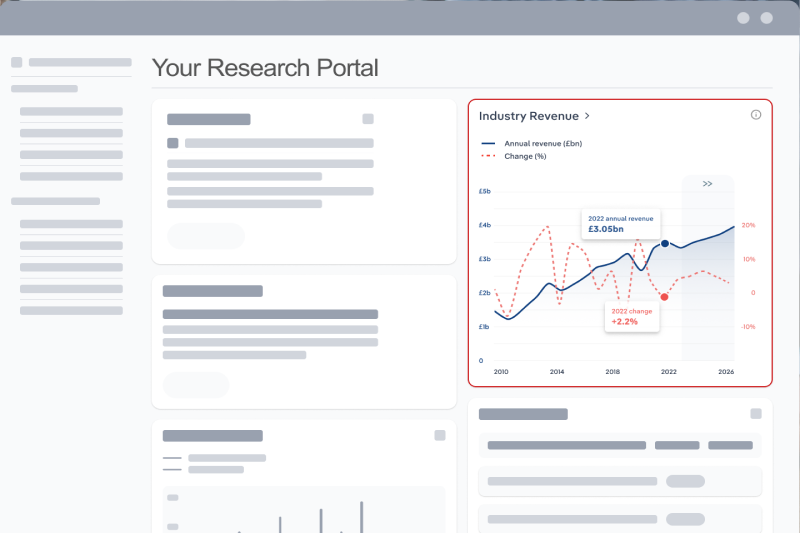
Streamline your workflow with IBISWorld’s intelligence built into your toolkit.
IBISWorld's research coverage on the Gyms & Fitness Centres industry in Ireland includes market sizing, forecasting, data and analysis from 2016-2031. The most recent publication was released January 2026.
The Gyms & Fitness Centres industry in Ireland operates under the SIC industry code R93.130IE. Companies in this industry provide fitness facilities, specifically gyms and health clubs. These organisations typically provide services on a membership basis and benefits include the use of exercise equipment and weights, personal training, group classes and other club facilities. Related terms covered in the Gyms & Fitness Centres industry in Ireland include cardio, yoga and smart gym.
Products and services covered in Gyms & Fitness Centres industry in Ireland include Membership, Personal training and Classes.
Companies covered in the Gyms & Fitness Centres industry in Ireland include Flyefit Holdings Ltd , Dalata Hotel Group plc and Barkisland (Developments) Ltd.
The Performance chapter covers detailed analysis, datasets, detailed current performance, sources of volatility and an outlook with forecasts for the Gyms & Fitness Centres industry in Ireland.
Questions answered in this chapter include what's driving current industry performance, what influences industry volatility, how do successful businesses overcome volatility, what's driving the industry outlook. This analysis is supported with data and statistics on industry revenues, costs, profits, businesses and employees.
The Products and Markets chapter covers detailed products and service segmentation and analysis of major markets for the for the Gyms & Fitness Centres industry in Ireland.
Questions answered in this chapter include how are the industry's products and services performing, what are innovations in industry products and services, what products or services do successful businesses offer and what's influencing demand from the industry's markets. This includes data and statistics on industry revenues by product and service segmentation and major markets.
The Geographic Breakdown chapter covers detailed analysis and datasets on regional performance of the Gyms & Fitness Centres industry in Ireland.
Questions answered in this chapter include where are industry businesses located and how do businesses use location to their advantage. This includes data and statistics on industry revenues by location.
The Competitive Forces chapter covers the concentration, barriers to entry and supplier and buyer profiles in the Gyms & Fitness Centres industry in Ireland. This includes data and statistics on industry market share concentration, barriers to entry, substitute products and buyer & supplier power.
Questions answered in this chapter include what impacts the industry's market share concentration, how do successful businesses handle concentration, what challenges do potential industry entrants face, how can potential entrants overcome barriers to entry, what are substitutes for industry services, how do successful businesses compete with substitutes and what power do buyers and suppliers have over the industry and how do successful businesses manage buyer & supplier power.
The Companies chapter covers Key Takeaways, Market Share and Companies in the Gyms & Fitness Centres industry in Ireland. This includes data and analysis on companies operating in the industry that hold a market share greater than 5%.
Questions answered in this chapter include what companies have a meaningful market share and how each company is performing.
The External Environment chapter covers Key Takeaways, External Drivers, Regulation & Policy and Assistance in the Gyms & Fitness Centres industry in Ireland. This includes data and statistics on factors impacting industry revenue such as economic indicators, regulation, policy and assistance programs.
Questions answered in this chapter include what demographic and macroeconomic factors impact the industry, what regulations impact the industry, what assistance is available to this industry.
The Financial Benchmarks chapter covers Key Takeaways, Cost Structure, Financial Ratios, Valuation Multiples and Key Ratios in the Gyms & Fitness Centres industry in Ireland. This includes financial data and statistics on industry performance including key cost inputs, profitability, key financial ratios and enterprise value multiples.
Questions answered in this chapter include what trends impact industry costs and how financial ratios have changed overtime.
The Industry Data chapter includes 10 years of historical data with 5 years of forecast data covering statistics like revenue, industry value add, establishments, enterprises, employment and wages in the Gyms & Fitness Centres industry in Ireland.
More than 6,000 businesses use IBISWorld to shape local and global economies
We were able to supplement our reports with IBISWorld’s information from both a qualitative and quantitative standpoint. All of our reporting now features some level of IBISWorld integration.

IBISWorld delivers the crisp business knowledge we need to drive our business. Whether it be serving up our major clients, winning new business or educating on industry issues, IBISWorld brings real value.

IBISWorld has revolutionised business information — which has proved commercially invaluable to exporters, investors and public policy professionals in Australia and overseas.

When you’re able to speak to clients and be knowledgeable about what they do and the state that they operate in, they’re going to trust you a lot more.

The market size of the Gyms & Fitness Centres industry in Ireland is €201.1m in 2026.
There are 234 businesses in the Gyms & Fitness Centres industry in Ireland, which has grown at a CAGR of 4.4 % between 2021 and 2026.
The Gyms & Fitness Centres industry in Ireland is unlikely to be materially impacted by import tariffs with imports accounting for a low share of industry revenue.
The Gyms & Fitness Centres industry in Ireland is unlikely to be materially impacted by export tariffs with exports accounting for a low share of industry revenue.
The market size of the Gyms & Fitness Centres industry in Ireland has been growing at a CAGR of 4.1 % between 2021 and 2026.
Over the next five years, the Gyms & Fitness Centres industry in Ireland is expected to grow.
The biggest companies operating in the Gyms & Fitness Centres industry in Ireland are Flyefit Holdings Ltd , Dalata Hotel Group plc and Barkisland (Developments) Ltd
Membership and Personal training are part of the Gyms & Fitness Centres industry in Ireland.
The company holding the most market share in the Gyms & Fitness Centres industry in Ireland is Flyefit Holdings Ltd .
The level of competition is high and increasing in the Gyms & Fitness Centres industry in Ireland.