


Key Takeaways
- Regulatory changes are expanding the number of businesses that need to understand and use plain language.
- Simplifying communications can dramatically reduce time spent reading and writing, speeding up product delivery and decision making.
- Artificial intelligence is changing the digital landscape, but plain language principles support effective implementation.
Keep it simple, stupid.
There’s a reason it’s a common saying, and it’s a phrase executives should take seriously. Simplified concepts have a much greater reach, and they tend to be quicker, easier and less costly to implement and understand. This principle has made it into many aspects of business, from streamlining supply chains to designing interfaces for websites and apps, but many firms overlook plain language when trying to simplify their operations.
As an editor, I often find myself shortening run-on sentences or switching out jargon for more well-known words. I’ve seen the opportunities that plain language offers from working with it, and many of these go unnoticed by businesses that undervalue reading and writing or only see it as a box to tick for accessibility requirements.
It can be so much more than that if you use it effectively.
What is plain language?
At its core, plain language ensures that what you’re writing is useful for the people reading it. The International Plain Language Federation defines it as communication where “wording, structure, and design are so clear that the intended readers can easily find what they need, understand what they find, and use that information.”
The International Organization for Standardization’s 2023 plain language standards refined this to four key principles:
- Readers receive relevant information
- Readers can easily find what they need
- Readers can easily understand the information presented to them
- Readers can easily use the information they find
Many believe accomplishing this means dumbing down content, but this isn’t true. Plain language is centered on what’s best for the reader. You can discuss the same concepts with depth and value. You just have to do it in a way that’s approachable for your target audience.
Regulation
Plain language is an important step towards inclusivity and accessibility, and pressure to implement it has grown over time as regulations expand globally. Failing to keep up with these changes puts a business at risk of legal consequences and reputational damage.
Several regulatory bodies, like the Australian Securities and Investments Commission and the United Kingdom’s Competition and Markets Authority, require businesses to use plain language in many contexts. Since June 2025, the European Union’s European Accessibility Act has also required that businesses like financial institutions and digital service providers use plain language as part of a range of accessibility measures.
Accessibility requirements are building momentum, and executives need to stay up to date with how they’re relevant to their business or face penalties. Plain language is one aspect of this trend, but it’s one that offers a range of benefits if you view implementing it as an opportunity rather than a chore.
The business case for plain language
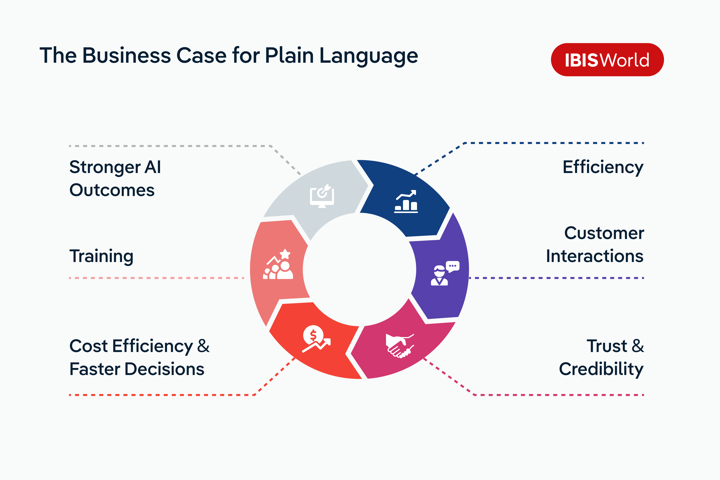
Opening the door to plain language creates opportunities to make your business more efficient and cost-effective. With environmental, social and governance (ESG) practices becoming increasingly visible and artificial intelligence (AI) taking hold, communicating clearly is also key to retaining consumers’ trust and remaining competitive.
Efficiency
While reading is the focus of most plain language discussion, it provides many benefits at the writing stage too.
Plain language can considerably cut down the time it takes to write things, by as much as 50% once trained. While this is partly because plain language documents tend to be shorter, using clearer writing from the outset keeps writers focused on the point of what they’re saying. Once the content gets to editors, it also means we spend less time restructuring text and copyediting.
Back-and-forth discussion between writers and editors is one aspect of the writing process that can drag on when working on complex texts. Using clearer, more focused writing means there’s less to question and editors can quickly identify if and how a change should be made. A faster editorial process means that content gets to market sooner, helping capture and retain customers looking for up-to-date information in an increasingly competitive information landscape.
Despite these efforts, revisions are inevitable. However, more straightforward writing – both in the original text and communication around queries – reduces room for misunderstandings and the need to rework things multiple times.
Customer interactions
Customer service is another aspect of business that’s reliant on conversations that can be made simpler with plain language. A 2004 trial by Canada-based Praxis Adult Training and Skills Development implemented plain language versions of customer service documents at a financial services firm.
The trial’s results highlight improved efficiency and service from the change in process. With plain language documents, the firm saw:
- a 10.5% drop in call duration
- a 77.1% reduction in employee errors
- a 36.9% increase in overall productivity
Not only were staff able to help more customers in a shorter timeframe, but the clearer documents meant they understood the material better and could find the information they needed faster to give customers higher quality support.
When surveyed after the trial, staff who used these documents were 61.2% more satisfied with them. Supporting staff with accessible resources means they’ll feel more comfortable and confident performing their duties and more satisfied with their job, boosting performance and retention in one move.
In 2024, the US Internal Revenue Service tried updating its notices for greater accessibility and saw a 16% fall in taxpayers calling customer support as their first action. This demonstrates the potential in offering customers clearer information. If customers can help themselves more easily, it lessens the burden on staff. This carries several benefits for the wider business, like improved staff retention and lower turnover costs.
Trust and credibility
With more and more consumers paying attention to their environmental footprint and how brands approach social issues, establishing and retaining trust can be a powerful source of demand. In contrast, one wrong step can drive consumers and businesses to boycott a brand.
A joint study by UK firms Fleet Street and Trajectory in 2024 examined how many consumers felt they could accurately define some of the language businesses use around sustainability. It noted that while consumers were more confident with some widely used terms like “net zero” – with 59% understanding – many still don’t fully grasp what businesses are saying. When it comes to terms that are more commonly seen in corporate communications, like “carbon offsetting”, that rate of understanding drops considerably, to 11% in this case.
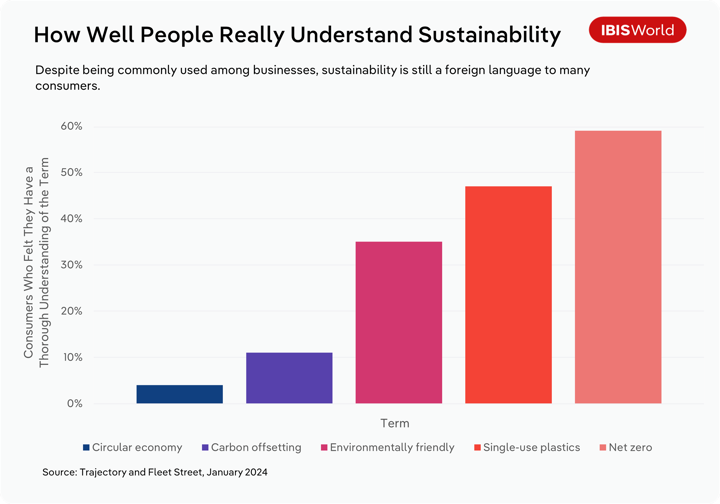
Similarly, Kantar New Zealand's 2024 Better Futures report surveyed people on what they understood a “net zero” label on packaging to mean. As with the 41% of people in the UK study who weren’t confident about the term, 30% of respondents in this survey said they didn’t know what it meant. The 2025 edition of the report also highlighted that 66% of consumers think that “the way businesses talk about their social and environmental commitments is confusing.”
This lack of understanding is a hurdle for businesses relying on eco-friendly credentials to stand out from competitors. If that many consumers don’t understand what you’re saying, that’s a lot of lost sales. Being clearer and avoiding jargon will reinforce your brand as one that they can actually trust to be doing the right thing.
There’s plenty of research out there suggesting that consumers want environmentally friendly options.
Some consumers may quickly choose these options over products that don’t promote themselves as environmentally friendly. However, this is an increasingly popular sales strategy. Consumers presented with multiple sustainable products are more likely to choose the product that clearly explains its environmental merits over the option that uses complex jargon.
In 2022, the Australian Competition and Consumer Commission reviewed 247 Australian businesses’ online presences and identified 57% as having made concerning claims in regard to sustainability and environmental credentials.
Regulators like this are only going to look closer at businesses’ ESG statements and marketing as time goes on. Using language that’s not fully understood, by either the writer or reader, leaves firms open to making misleading claims without realizing it. Clearer statements reduce this risk, building trust with regulators and stakeholders, and avoiding unfavorable coverage that would influence consumers’ opinions.
That 2025 Kantar survey also noted that 47% of consumers think businesses are dishonest when discussing social and environmental issues. This means you already need to work for their trust.
Knowing what a business is really doing, and seeing them being open and clear about it, builds confidence in a brand. That becomes the first step towards securing a loyal customer base.
Even in more formal communications, being clear about your actions and goals supports success. A 2017 article in the Journal of Financial Economics examined the effects of writing financial disclosure documents in plain language. It found that more complex writing could reduce shareholders’ valuation of a firm by 2.5%, and up to 3.3% in situations where investors are more reliant on annual reports.
Across all contexts, if someone can easily understand what your company is doing, they’ll be more willing to buy into it.
Cost efficiency and faster decisions
Plain language comes back to ensuring that content is right for its audience. When used internally, that audience is executives and staff relying on information to make decisions and take action.
A 1991 study compared US naval officers’ reading time across plain and traditional bureaucratic report styles. It found that officers read the plain language version 17.2% faster.
Using the average hourly wage for naval officers and a baseline of reading 50 pages per week, the authors estimated that US$26.5 million worth of time could be saved per year if all memos were written in plain language. That’s just based on reading time without considering the time that would be saved writing in this style.
Reading fast is one thing, but being able to use that information is another. That’s why the study also examined how well officers understood what they’d read.
Those who’d read the simpler version could answer comprehension questions correctly at a higher rate, and half as many felt they needed to reread the materials to adequately understand the content.
Changing processes so that the reports and briefs that come across your desk are simpler means you can review more of them with confidence that you understand the matters at hand and can make the right decisions for your business. Misread information at the executive level can threaten a business’s financial performance and reputation, so working with clearly written documents will reduce risk in day-to-day operations.
Training
What about at the other end of the business? Offering accessible training resources can speed up the onboarding and upskilling processes by providing guidance in a more digestible way.
Consider a time when you’ve started a new job. That in itself can be overwhelming. If you’re then presented with a pile of information that you need to learn quickly, it can be intimidating, slowing down learning.
Changing your methods so that training is delivered through clear and direct instructions and explanations will help staff learn faster. With UK businesses spending around £2,710 per trainee according to the Department for Education’s 2024 Employer Skills Survey, simplifying and shortening this process has the potential to bring down costs and means staff can contribute more to the company sooner.
Stronger AI outcomes
Bringing AI into business operations comes with risks, but plain language offers a way to reduce them.
Many fields are training customized AI tools to automate processes. While some sectors, like agriculture, are using images, others, like legal services, are using text.
Training an AI on plain language content means it will write in this style more consistently. The clarity in its training material also means it can be more accurate in its responses. For firms that want a tool that generates communications and reports, this could be an appealing option.
Furthermore, plain language means that all readers can understand AI-generated content the same way, with less room for misinterpretation. This makes discussions among decision makers faster and more constructive.
Many AI large language models use an authoritative voice, making them sound reliable. However, these tools commonly make mistakes and introduce incorrect information, known as hallucinating. If an AI is writing in plain language, it’s a lot easier to spot these errors before they make it far enough to influence business decisions.
However, training an AI is a time-intensive and expensive process, putting customized AI tools out of reach for most businesses.
Chat tools
Several industries, from internet service providers to commercial banks, are introducing AI chat tools on their websites and apps. When implemented effectively, these tools provide a convenient alternative to calling or emailing a business, particularly for simple issues. With staff freed up, labor costs can go towards dealing with more complex and nuanced cases instead, where humans can achieve better results and customers will value that interaction more.
As more firms introduce these tools, ensuring that they appeal to customers will be important to staying ahead of competitors. Plain language has a role to play in boosting that appeal through three key aspects: usability, functionality and reliability.
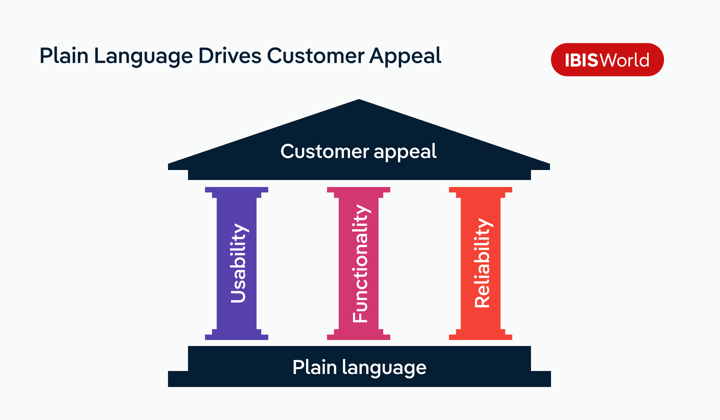
Making these tools use plain language in their responses means customers will see them as more usable, since they can interact with them using conversational writing. This ease of use will contribute to the tool being able to perform the functions it needs to effectively, helping consumers see it as a viable method of resolving their questions and issues.
Using plain language will also support customers’ ability to consistently get the results they want from these tools, encouraging use. Tools that don’t reliably help customers resolve their problems will push traffic back onto staff. Unsuccessful interactions with these tools can also reflect poorly on the company.
Incorporating plain language into AI tools ensures that they become reliable assets to support your firm and not liabilities.
Making plain language part of your organization
Adopting plain language doesn’t happen overnight. Exploring the options available to create a structured approach will mean you don’t waste time and resources in the process of making changes.
Use regulations as a framework
Any regulations that apply to your business provide a starting point for how to implement plain language. Addressing regulatory needs should be a priority in any strategy you adopt to limit risks to the business. This limits legal and reputational risks while also moving you closer to what stakeholders and customers expect.
Make it a companywide change
Keeping plain language practices to isolated areas of your business is inefficient. This change offers benefits throughout a company, from customer-facing products to board papers and executive reports, so bringing everyone on board will allow you to maximize your results.
Lead by example
Seeing executives committed to improving clarity and accountability will encourage other staff to get on board. This is an opportunity for you to showcase how to communicate more effectively and set the example that others follow. Plain language also helps make communications sound more human, building trust with staff and reinforcing credibility with external stakeholders.
Invest in training
While the principles behind plain language are straightforward, training is a valuable step towards success. Ensuring that employees understand how to follow guidelines and feel confident applying them will go a long way to delivering value sooner. Many organizations promoting plain language offer resources and training courses, so use their expert knowledge to make the most of this change.
Introduce standards
Having structured guidance detailing how to use plain language will give staff something to refer back to when they’re unsure, providing confidence and support. Documentation like this will ensure plain language is applied consistently throughout your operations for better results. It’s important to note that any resources like this need to be written in plain language themselves.
Tailor your guidance
Remember that plain language is all about writing for your audience. Make sure that any resources you adopt align with your operations and your customers for the best results.
Final Word
Language is one of the most powerful tools in the world and many people take it for granted.
Regulations requiring businesses to use plain language are expanding because of its ability to bring information to a wider audience. This shouldn’t be seen as a box-ticking exercise, but as a strategic tool to make the most of what you say and how you say it.
Seizing this opportunity provides a means to save time and money in your operations. It can create a better environment for your staff, improving productivity and satisfaction. It can make your business stand out from competitors online and on shelves.
That’s not a possibility that should be overlooked.
So... keep it simple, stupid.