
 IBISWorld Platform
 Integrations
 Microsoft Copilot
 Claude
 ChatGPT
IBISWorld Platform
Answer any industry question in minutes with our entire database at your fingertips.

The virtual reality software industry has grown rapidly in recent years as the technology has become more accessible and refined across markets. Advances in headset performance and interaction design have widened the VR user base, fueling demand for increasingly sophisticated and interactive software. Gaming and entertainment remain the primary growth driver, though adoption in education, healthcare and workplace training has added meaningful momentum. Combined with growing integration of artificial intelligence, the industry is seeing substantial activity and expansion potential. Industry revenue has climbed at a CAGR of 18.7% to reach $10.8 billion in 2026, including an expansion of 9.8% in 2026 alone.Over the past five years, the combined efforts of established tech firms, startups and academic institutions have generated real momentum for the VR software industry. Apple's Vision Pro launched at a price above $3,000, yet average VR hardware costs have declined over time, helping the industry extend beyond an affluent, early-adopter audience toward broader consumer segments. Meta's Reality Labs division has posted large operating losses tied to slower-than-expected metaverse adoption, and average industry profit still trails the broader tech sector, yet overall industry growth has remained strong. VR applications in healthcare, spanning patient therapy and surgical planning, continue to drive new clinical use cases, while demand for VR in professional training continues to expand across sectors.Through the end of 2031, the VR software industry is expected to maintain its upward trajectory, albeit at a more moderate pace. Continued integration of AI tools should sustain productivity gains and user interest, while upcoming headsets with lighter, more comfortable designs are likely to support wider adoption across consumer and enterprise markets. Major providers like Meta haven't yet achieved profitability in VR, but the industry's outlook remains solid, given sustained capital expenditure on the technology, which will lead to revenue expanding at a 7.6% CAGR to reach $15.6 billion in 2031.
Explore the flexible connection options to access data and analysis.
IBISWorld's research coverage on the Virtual Reality Software Developers industry in the United States includes market sizing, forecasting, data and analysis from 2016-2031. The most recent publication was released August 2026.
The Virtual Reality Software Developers industry in the United States operates under the NAICS industry code OD6181. The Virtual Reality Software industry involves companies developing software and related products to offer users an immersive experience within a 3D digital environment. The industry includes applications for gaming, training, simulations and various other interactive experiences. These companies use advanced technologies like computer graphics, motion tracking and sensory feedback to create realistic and engaging virtual worlds. Related terms covered in the Virtual Reality Software Developers industry in the United States include mixed reality (mr), immersive technology, haptic feedback and room scale.
Products and services covered in Virtual Reality Software Developers industry in the United States include Software Development Kits (SDKs), Content Management Systems (CMS) and Operating Systems (OS).
Companies covered in the Virtual Reality Software Developers industry in the United States include Meta Platforms, Inc., Apple Inc. and Sony Corporation.
The Performance chapter covers detailed analysis, datasets, detailed current performance, sources of volatility and an outlook with forecasts for the Virtual Reality Software Developers industry in the United States.
Questions answered in this chapter include what's driving current industry performance, what influences industry volatility, how do successful businesses overcome volatility, what's driving the industry outlook. This analysis is supported with data and statistics on industry revenues, costs, profits, businesses and employees.
The Products and Markets chapter covers detailed products and service segmentation and analysis of major markets for the for the Virtual Reality Software Developers industry in the United States.
Questions answered in this chapter include how are the industry's products and services performing, what are innovations in industry products and services, what products or services do successful businesses offer and what's influencing demand from the industry's markets. This includes data and statistics on industry revenues by product and service segmentation and major markets.
The Geographic Breakdown chapter covers detailed analysis and datasets on regional performance of the Virtual Reality Software Developers industry in the United States.
Questions answered in this chapter include where are industry businesses located and how do businesses use location to their advantage. This includes data and statistics on industry revenues by location.
The Competitive Forces chapter covers the concentration, barriers to entry and supplier and buyer profiles in the Virtual Reality Software Developers industry in the United States. This includes data and statistics on industry market share concentration, barriers to entry, substitute products and buyer & supplier power.
Questions answered in this chapter include what impacts the industry's market share concentration, how do successful businesses handle concentration, what challenges do potential industry entrants face, how can potential entrants overcome barriers to entry, what are substitutes for industry services, how do successful businesses compete with substitutes and what power do buyers and suppliers have over the industry and how do successful businesses manage buyer & supplier power.
The Companies chapter covers Key Takeaways, Market Share and Companies in the Virtual Reality Software Developers industry in the United States. This includes data and analysis on companies operating in the industry that hold a market share greater than 5%.
Questions answered in this chapter include what companies have a meaningful market share and how each company is performing.
The External Environment chapter covers Key Takeaways, External Drivers, Regulation & Policy and Assistance in the Virtual Reality Software Developers industry in the United States. This includes data and statistics on factors impacting industry revenue such as economic indicators, regulation, policy and assistance programs.
Questions answered in this chapter include what demographic and macroeconomic factors impact the industry, what regulations impact the industry, what assistance is available to this industry.
The Financial Benchmarks chapter covers Key Takeaways, Cost Structure, Financial Ratios, Valuation Multiples and Key Ratios in the Virtual Reality Software Developers industry in the United States. This includes financial data and statistics on industry performance including key cost inputs, profitability, key financial ratios and enterprise value multiples.
Questions answered in this chapter include what trends impact industry costs and how financial ratios have changed overtime.
The Industry Data chapter includes 10 years of historical data with 5 years of forecast data covering statistics like revenue, industry value add, establishments, enterprises, employment and wages in the Virtual Reality Software Developers industry in the United States.

Answer any industry question in minutes with our entire database at your fingertips.
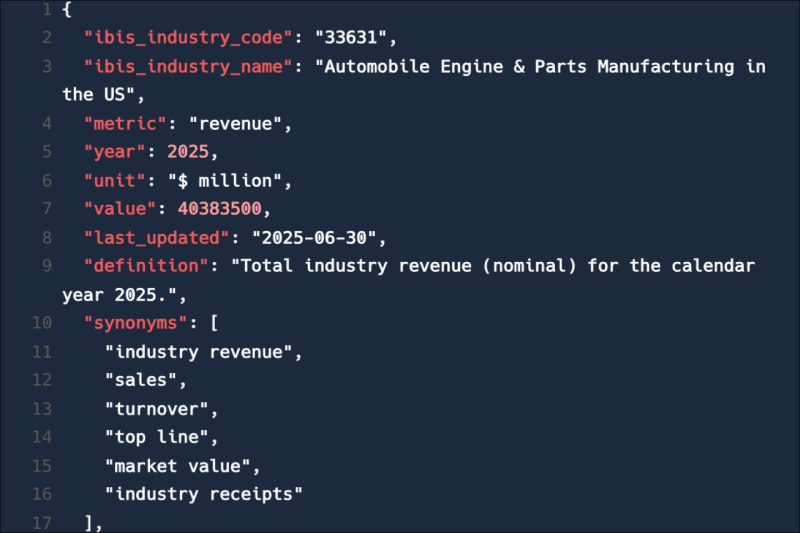
Feed trusted, human-driven industry intelligence straight into your platform.

Streamline your workflow with IBISWorld’s intelligence built into your toolkit.
More than 6,000 businesses use IBISWorld to shape local and global economies
We were able to supplement our reports with IBISWorld’s information from both a qualitative and quantitative standpoint. All of our reporting now features some level of IBISWorld integration.

IBISWorld delivers the crisp business knowledge we need to drive our business. Whether it be serving up our major clients, winning new business or educating on industry issues, IBISWorld brings real value.

IBISWorld has revolutionised business information — which has proved commercially invaluable to exporters, investors and public policy professionals in Australia and overseas.

When you’re able to speak to clients and be knowledgeable about what they do and the state that they operate in, they’re going to trust you a lot more.

The market size of the Virtual Reality Software Developers industry in the United States is $10.8bn in 2026.
There are 596 businesses in the Virtual Reality Software Developers industry in the United States, which has grown at a CAGR of 25.8 % between 2021 and 2026.
The Virtual Reality Software Developers industry in the United States is unlikely to be materially impacted by import tariffs with imports accounting for a low share of industry revenue.
The Virtual Reality Software Developers industry in the United States is unlikely to be materially impacted by export tariffs with exports accounting for a low share of industry revenue.
The market size of the Virtual Reality Software Developers industry in the United States has been growing at a CAGR of 18.7 % between 2021 and 2026.
Over the next five years, the Virtual Reality Software Developers industry in the United States is expected to grow.
The biggest companies operating in the Virtual Reality Software Developers industry in the United States are Meta Platforms, Inc., Apple Inc. and Sony Corporation
Software development kits and Cloud-based services are part of the Virtual Reality Software Developers industry in the United States.
The company holding the most market share in the Virtual Reality Software Developers industry in the United States is Meta Platforms, Inc..
The level of competition is moderate and steady in the Virtual Reality Software Developers industry in the United States.